
Optics & Photonics Precision Part Solutions
Optical and photonic parts push line width, hole size and flatness close to the limit, where one burr changes performance. LCJMI Precision combines laser cutting and chemical etching for slits, apertures and encoder disks, with precision at ±0.005mm and flatness within 0.005mm.
1. Four Optical Production Challenges
- Micron-level accuracy: slit width, hole size and pitch often sit at 0.02mm, with very tight tolerance.
- Edge quality: burrs, taper, dark edges and heat marks all affect transmission and imaging, so edges must stay clean.
- Ultra-thin warping: sheet from 0.01mm to 0.3mm curls during processing and handling, which hurts flatness.
- Cleanliness: optical parts allow no oil, residue or scratches on either surface.
2. Combined Process Solution
- Precision laser cutting, fiber or ultrafast, handles slits, apertures, encoder disks and light-blocking masks with no contact stress.
- Chemical etching handles thin openwork filter frames, metal masks and screens, with no mechanical stress and good flatness.
- Inspection uses a 2D vision system and an optical projector to check slit width and hole position part by part.
- The logic is feature-driven: laser for slits and outlines, etching for ultra-thin openwork, together for accuracy and flatness.
3. Typical Parts
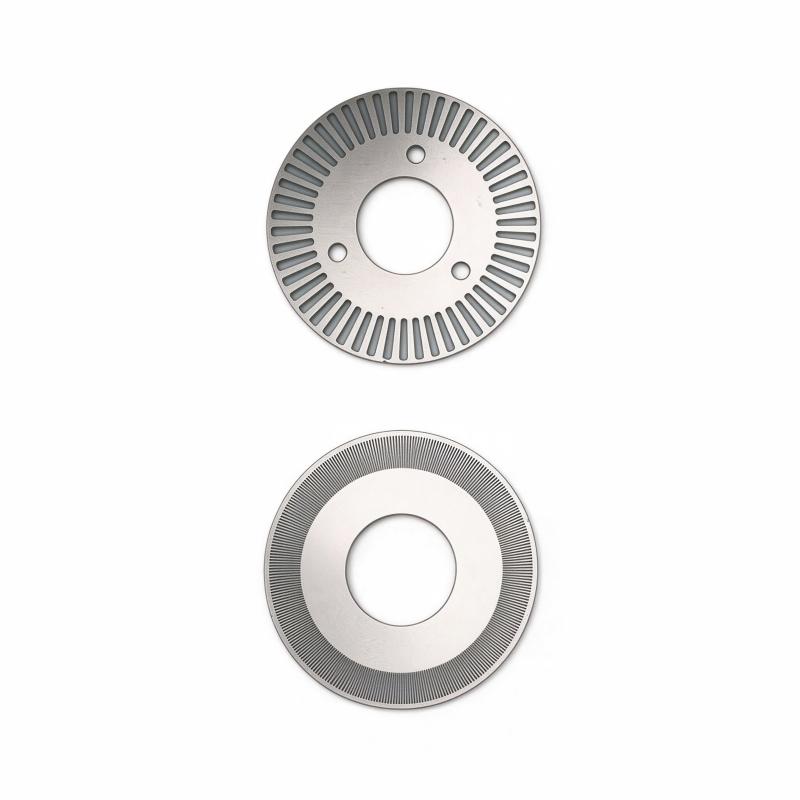
Slit plates, aperture stops, encoder disks, grating plates, light-blocking masks, filter frames, lens spacers, laser metal parts and optical masks.
4. Material and Accuracy Table
| Item | Capability |
|---|---|
| Machinable materials | Stainless steel, copper, nickel, molybdenum, Invar, Kovar |
| Material thickness | 0.01–1.5mm |
| Slit width | 0.02mm |
| Standard tolerance | ±0.01mm for etching and laser |
| Tight tolerance | ±0.005mm |
| Flatness | Within 0.005mm |
| Sampling lead time | Urgent samples in 4 hours; regular 3–5 working days |
5. Quality and Delivery Guarantee
- Slit parts are checked one by one for width and spacing, and batch sampling runs at no less than 15 percent.
- Every shipment carries an inspection report, and measured data is available for critical dimensions.
- Processing and packing run in a clean environment to keep oil and scratches away.
- Shenzhen Guangming takes orders and Dongguan Hengli produces them, with same-day process review in the Pearl River Delta.
6. Production Cases
- Case one: an encoder disk needed slit spacing within ±0.005mm, and laser plus etching held flatness within 0.005mm with clean slit edges.
- Case two: a 0.05mm metal mask with complex openwork was etched in one pass, with no stress, no warp and stable pattern consistency.
7. Process and Selection Advice
- Slit design: keep the depth-to-width ratio moderate, because deep narrow slits raise difficulty and cost sharply.
- Ultra-thin sheet: leave process edges on sheet below 0.05mm for clamping and handling, which limits deformation.
- Panel layout: group small slits and apertures on one panel to raise material use and hold consistency.
- Post-treatment: note coating, blackening or polishing on the drawing so the steps can be scheduled.
- Tolerance: mark critical dimensions and datums clearly so we can control them against the drawing.
8. Frequently Asked Questions
How narrow can a slit be?
A: Ultra-thin optical parts can reach 0.02mm, standard etching holds 0.07mm, and laser reaches about 0.02mm depending on thickness.
Will ultra-thin parts deform after processing?
A: Etching adds no stress and holds flatness well, while laser uses step cutting and stress relief on thin sheet.
Can slit spacing consistency be guaranteed?
A: Yes. Slit parts are measured one by one, and spacing uniformity follows the tolerance on your drawing.
9. Get Your Production Plan
Send drawings or optical part requirements, and our engineers recommend laser, etching or a combination, then quote within 1 hour.
Send your drawings, get a preliminary quote within 10 minutes
Supports CAD / PDF / DXF / STEP. Specify material, thickness and quantity. Free process evaluation from our engineers.